


Zeeland
Domburg: 2,000 years of history by the sea
By Ard Breure · Published 20 September 2026
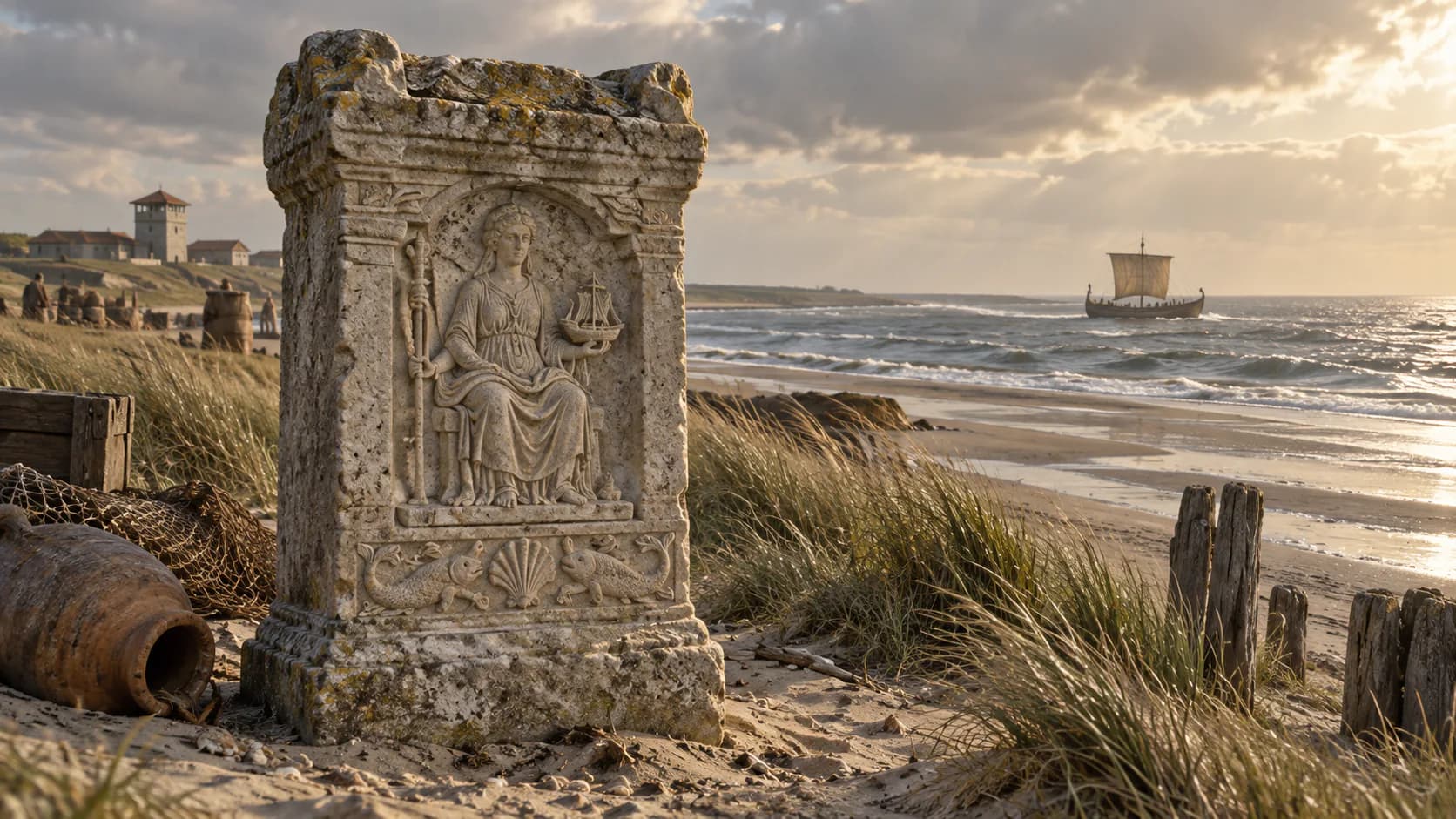
On 5 January 1647, a violent winter storm battered Walcheren on the Dutch North Sea coast. At the small seaside town of Domburg, the sea tore away parts of the dunes. When the water receded, it revealed something that had been hidden there for centuries: stone altars from the Roman period.
The same name appeared on several of them. Nehalennia.
Almost fifteen centuries after Roman merchants and sailors had worshipped her, the goddess appeared again on the Zeeland coast.
It is an almost perfect opening scene for the history of Domburg. Behind today's image of beaches, terraces and holiday homes lies a past far larger than the size of the town would suggest.
Roman traders came here. Vikings attacked Walcheren. Medieval rulers granted Domburg town privileges. European aristocrats came to take the cure. Artists discovered the distinctive Zeeland light.
And before Piet Mondrian painted his famous compositions of black lines and primary colours, he painted the dunes, church towers and sea around Domburg.
The history of Domburg is therefore much more than the story of a seaside resort. It is almost two thousand years of European history, concentrated on one small stretch of Dutch coast.
A goddess on the North Sea
Anyone looking out over the North Sea from Domburg today sees beaches, ships on the horizon and, on a clear day, an endless strip of water. Two thousand years ago, that same sea formed part of a busy trading network within the Roman Empire.
Ships carried goods between the regions we now call the Netherlands, Belgium, France and England. The crossing was dangerous. Storms could arise suddenly, and navigation on the North Sea was a risky business.
For protection, merchants and sailors turned, among others, to Nehalennia. We do not know exactly who she was. Nehalennia was not a classical Roman goddess like Jupiter or Venus. Her cult probably had local Celtic or Germanic roots that were later absorbed into the religious world of the Roman Empire.
She is often depicted with a dog, baskets of fruit or other symbols of trade and prosperity. Her connection with the sea is especially important. After a safe crossing, merchants could dedicate a stone altar in gratitude for her protection.
Centuries later, many of those altars disappeared beneath water and sand as the coastline changed. Until the storm of 1647.
The finds at Domburg immediately attracted the attention of scholars. Drawings of the stones were made that same year for Constantijn Huygens, who, as lord of Domburg, had a formal claim to objects found on the beach. The Roman past of the Zeeland coast was therefore documented remarkably early.
The fire that destroyed part of the past
The stones were eventually kept in Domburg's church. They appeared to be safe there. They were not.
On 11 October 1848, severe weather struck Domburg again. Lightning hit the church tower. The tower caught fire and eventually collapsed into the church. The building was almost completely destroyed, and a significant part of the Roman collection was lost or badly damaged.
Yet the story of Nehalennia survived. The seventeenth-century drawings had been preserved. Shortly before the fire, a published set of plates had also recorded the finds with the involvement of the archaeological museum in Leiden. Part of what disappeared physically therefore survived on paper.
Vikings on the coast
After Roman authority disappeared, Walcheren changed dramatically. The North Sea remained important. In the early Middle Ages, the trading settlement of Walichrum lay in this area, a name connected with the later Walcheren.
Its coastal position brought trade, but also danger. During the ninth century, Viking fleets increasingly appeared along the coasts and rivers of Western Europe. Walcheren was attacked as well.
In 837, Vikings raided the area. Historical sources record that Eggihard, the count of Walcheren, was killed.
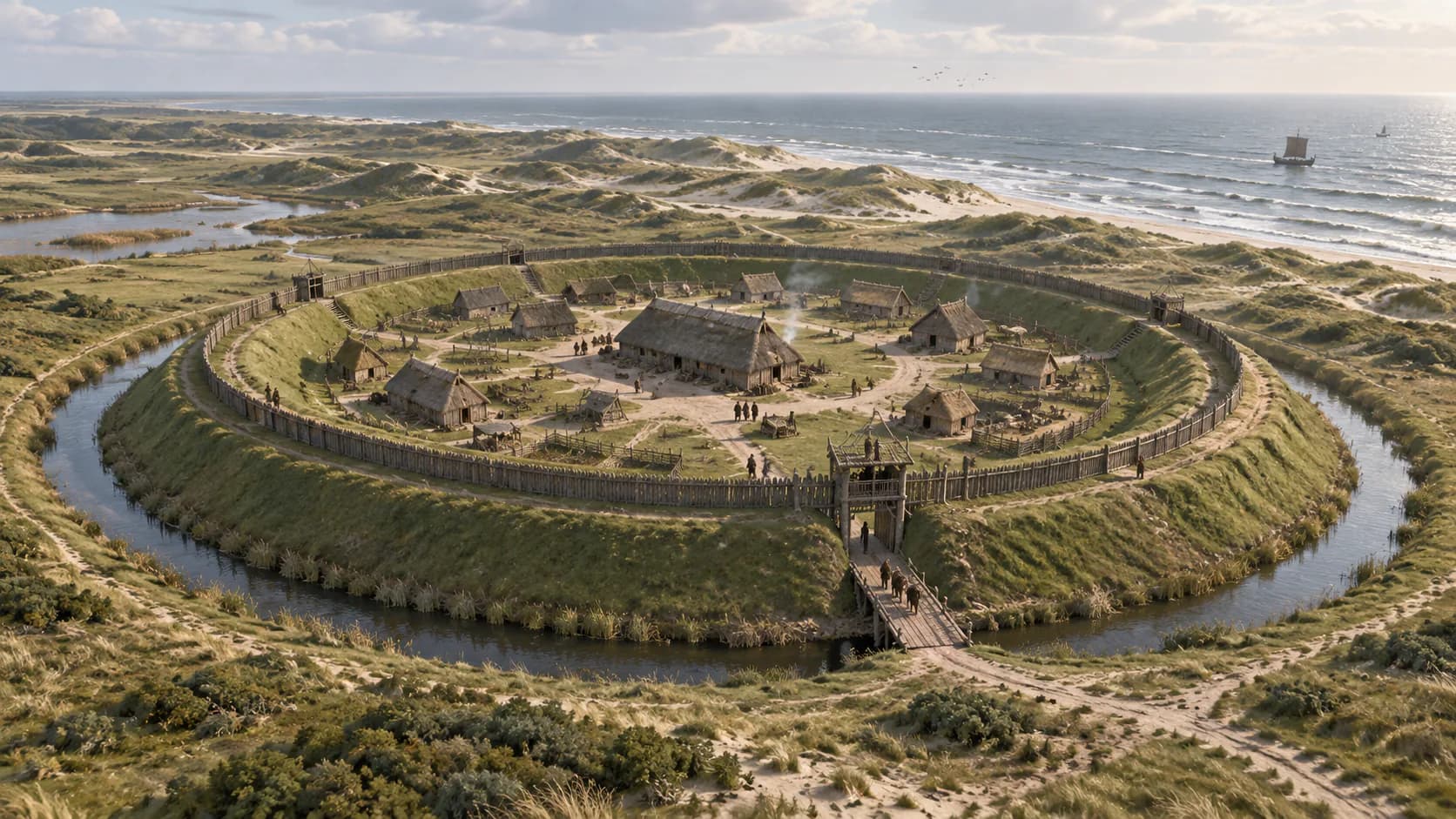
The major defensive works associated with this period did not appear immediately after that attack. Only in the final quarter of the ninth century were three large ring forts built on Walcheren, probably in response to the continuing threat of further Viking raids. They stood at Domburg, Middelburg and Souburg.
The fort at Domburg was known as Duinburg. It had a diameter of about 265 metres, making it the largest of the three Walcheren ring forts.
Archaeological excavations in 1991 uncovered parts of it, including remains on the grounds of the Badhotel. The centre of the old fort lay roughly at today's junction of Wijngaardstraat and Badstraat. Even Domburg's present street pattern still carries traces of that early medieval past.
The town's name probably refers to it as well. Domburg is a later form of Duinburg.
An English ship beneath Domburg
Archaeology also shows how international this coast already was more than a thousand years ago. Inside the Domburg ring fort, near the present Badstraat, wooden planking was found that had once formed part of an Anglo-Saxon ship.
It was a clinker-built vessel, a construction method in which the wooden planks overlap. The oak was dated to the eighth century, and the ship has been linked with Hamwic, the important Anglo-Saxon trading settlement from which Southampton later developed.
The timber had been reused in Domburg. In the ground beneath this small Zeeland town lies material from a ship that once belonged to the trading world on the other side of the North Sea.
The sea did not merely separate these regions. It connected them.
A town that looks like a village
Most visitors would probably call Domburg a village. Historically, that is not quite right.
In 1223, Domburg received town privileges. Floris IV, Count of Holland, and Dirk of Voorne granted those rights to Domburg and Westkapelle at the same time.
Domburg never developed into a large town like Middelburg. It remained small. That is precisely what makes its history interesting: Domburg acquired urban rights while retaining the character of a small coastal community.
For centuries, its inhabitants lived from agriculture, trade, fishing and activities directly or indirectly connected with the sea. That same sea could bring prosperity, but it could also destroy. Storm floods, shifting sands and a constantly changing coastline all helped shape the history of Walcheren.
In the nineteenth century, the relationship with the sea changed again. For the first time, it became an attraction.
The birth of the seaside resort
At the beginning of the nineteenth century, Europe developed a new fascination with seawater and sea air. Doctors prescribed bathing in the sea for a wide range of conditions. Going to the coast was not yet a holiday in the modern sense. It could be part of a medical regimen.
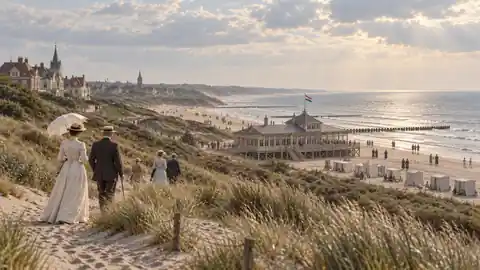
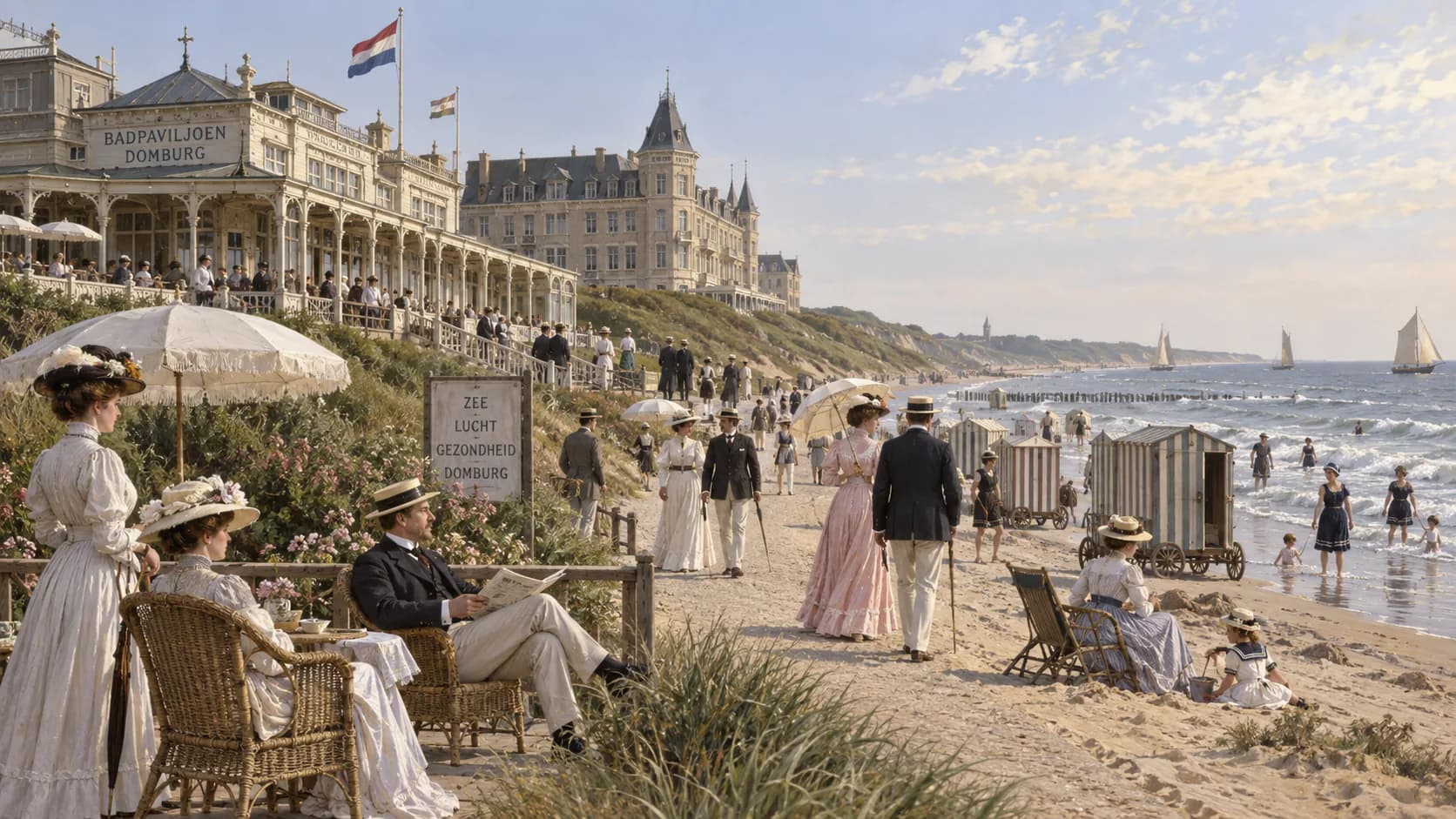
In 1834, two families from Middelburg took a sea bath at Domburg using bathing machines. That year is generally regarded as the beginning of Domburg as an organised seaside resort.
Three years later came an important step. On 28 March 1837, the foundation stone was laid for a coffee and bathing pavilion on the dunes. The building was designed by Gerardus Grauss, and even King William I contributed financially.
The Badhotel opened in 1866. Access improved as well. Middelburg gained a railway connection on 1 March 1872, and from 1906 a steam tram ran to Domburg.
The Zeeland coast moved closer to the major cities. But one man in particular helped give Domburg an international reputation.
The doctor to Europe's elite
His name was Johann Georg Mezger. Mezger was a physician who became internationally famous for his massage treatments. His methods contributed to the development of what would later become modern physiotherapy.
From 1885, he was a regular visitor to Domburg. In 1887 he had Villa Irma built there. His patient list was extraordinary and included Empress Elisabeth of Austria, Tsarina Maria Feodorovna of Russia and King Gustaf V of Sweden.
When a physician with such a reputation stayed in a small Zeeland resort, it had consequences. Europe's elite discovered Domburg. Hotels, villas, bathing facilities and meeting places appeared near the coast. Domburg became fashionable.
Carmen Sylva
One of the most famous visitors was Elisabeth of Romania. The queen was not only a monarch, but also a poet and writer. She published under the pen name Carmen Sylva.
In 1889, she stayed in Domburg for about a month. She lodged at Villa Duinoord, a building that no longer exists, but spent much of her time at Carl Erbschloe's Villa Maria. After her visit, the villa was renamed after her literary pseudonym: Villa Carmen Sylva.
The building still stands. It is a tangible reminder of the period when members of European royal families came to Domburg for rest, health and treatment.
The architecture of a new resort
Domburg's rapid development also produced its own architectural identity. The Badhotel opened in 1866 and became part of the growing infrastructure for seaside visitors.
Architect Johannes van Nieukerken later helped shape fashionable Domburg. He designed Villa Carmen Sylva and the new Badpaviljoen, which was built in 1888 and 1889. High on the dunes stood a building perfectly suited to the new Domburg. Visitors could read, play billiards, socialise and look out over the North Sea. Newspapers and magazines from several European countries were available in the reading room.
Domburg around 1900 should therefore not be imagined merely as a place of simple houses and fishing boats. There were hotels and villas, doctors, artists and wealthy families, foreign newspapers and visitors from across Europe.
Domburg was small. But the world came in.
Then the artists arrived
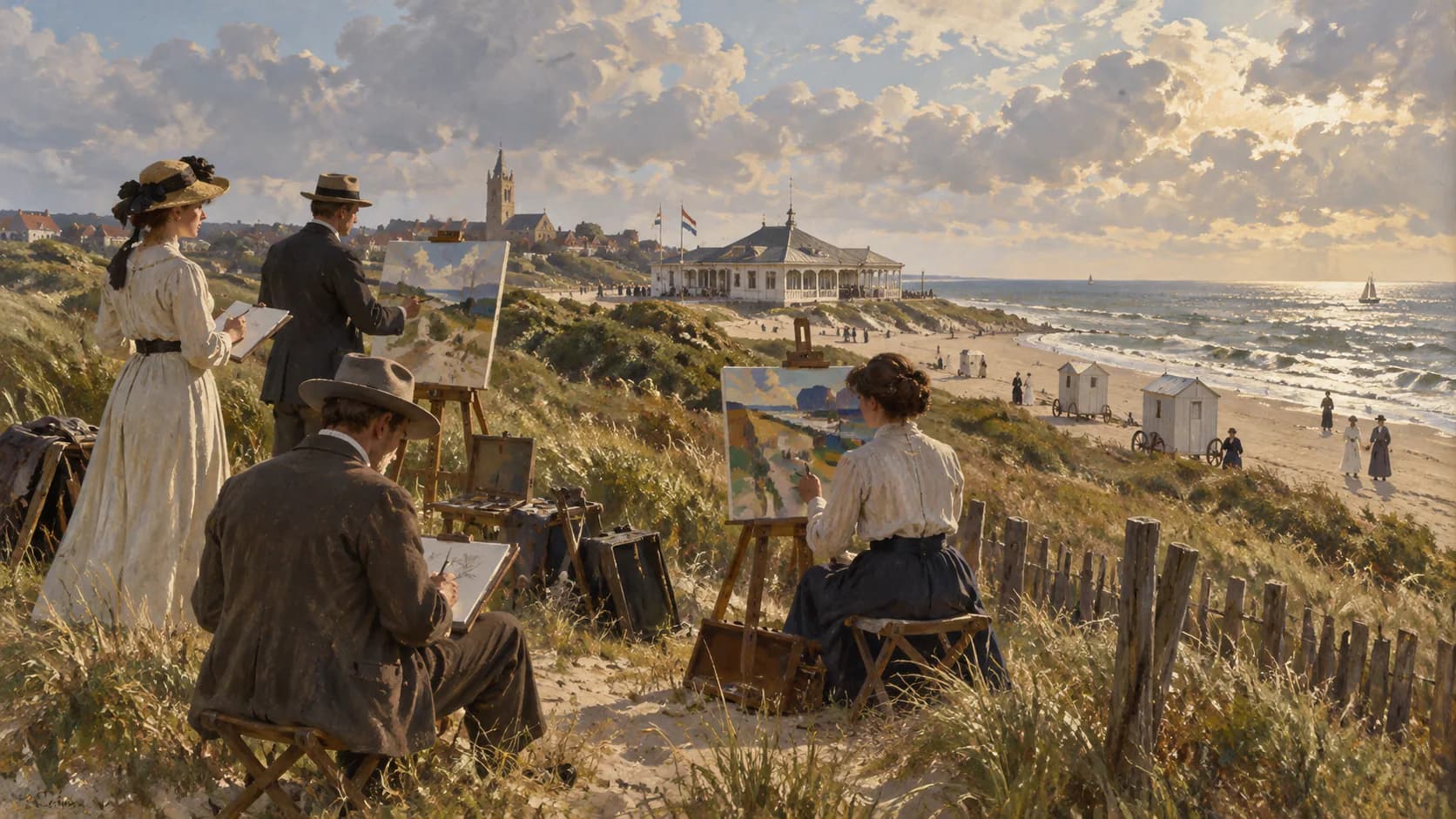
Perhaps it was inevitable that artists would discover Domburg. The light on the Zeeland coast changes constantly. Clouds move quickly across the landscape. The sea reflects the sky. Dunes, dikes and beaches create long horizontal lines.
One of the artists drawn to it was Jan Toorop. Around 1900, Toorop was one of the Netherlands' most important artists. His work moved between symbolism, pointillism, Art Nouveau and other modern movements.
He returned regularly to Domburg and became a central figure in the artistic community that developed there. Other painters followed. Domburg became not only a fashionable seaside resort, but also an artists' colony.
In the summer of 1908, another painter arrived in Domburg, one who would later become world famous: Piet Mondrian.
Before Mondrian painted grids, he painted Domburg
Today, Mondrian is almost instantly associated with abstract compositions: white fields, black horizontal and vertical lines, red, yellow and blue.
But his development towards abstraction came step by step. Domburg played an interesting role in that process. In the summer of 1908, Mondrian spent about two weeks in Domburg at the invitation of Jan Toorop. He later returned to Walcheren several times.
He painted dunes, trees, seascapes, buildings and church towers. Seen beside his earlier work, something begins to change. Forms grow stronger. Details disappear. Colours become less naturalistic. The visible world remains recognisable, but is increasingly reduced to rhythm, line and plane.
That is what makes the Zeeland period so fascinating. You can almost watch an artist in transition. A painter recording a landscape begins to search for the structure behind that landscape.
Long before Mondrian became the artist of world-famous geometric compositions, he stood on the Zeeland coast and painted Domburg.
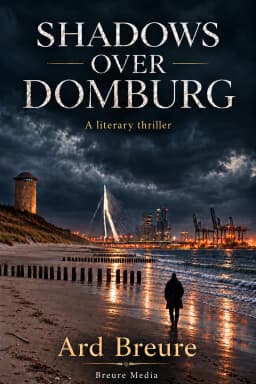
That combination of dunes, history and constantly changing light is also why I chose Domburg as the setting for my novel Shadows over Domburg.
Curious how Domburg works as a setting in fiction? I’ll send you the first chapter of Shadows over Domburg free by email.
Get the first chapter free
When the tide went out at Domburg that morning, a man was lying on the beach. The watch was still on his wrist. The screen was still lit.
An art pavilion in the dunes
The artistic community eventually gained its own exhibition space. At Jan Toorop's initiative, a simple white wooden pavilion was built.
On Saturday 29 July 1911, the first Domburg Exhibition opened there. During the summer months, artists could show and sell their work. The exhibitions were held from 1911 through 1921, with an interruption in 1918.
Mondrian took part in 1911 and 1912. It must have been a remarkable combination: international resort guests in hotels and villas on one side, artists experimenting with new forms of painting on the other, and in between them the residents of a small Zeeland town.
The pavilion did not survive. It was destroyed by a storm in the winter of 1921 to 1922. Since 1994, a building in central Domburg has once again referred to the original pavilion. Today it houses the Marie Tak van Poortvliet Museum.
A world disappears
The First World War had already broken the rhythm of Domburg's international heyday. Travel became more difficult and the fashionable resort life changed.
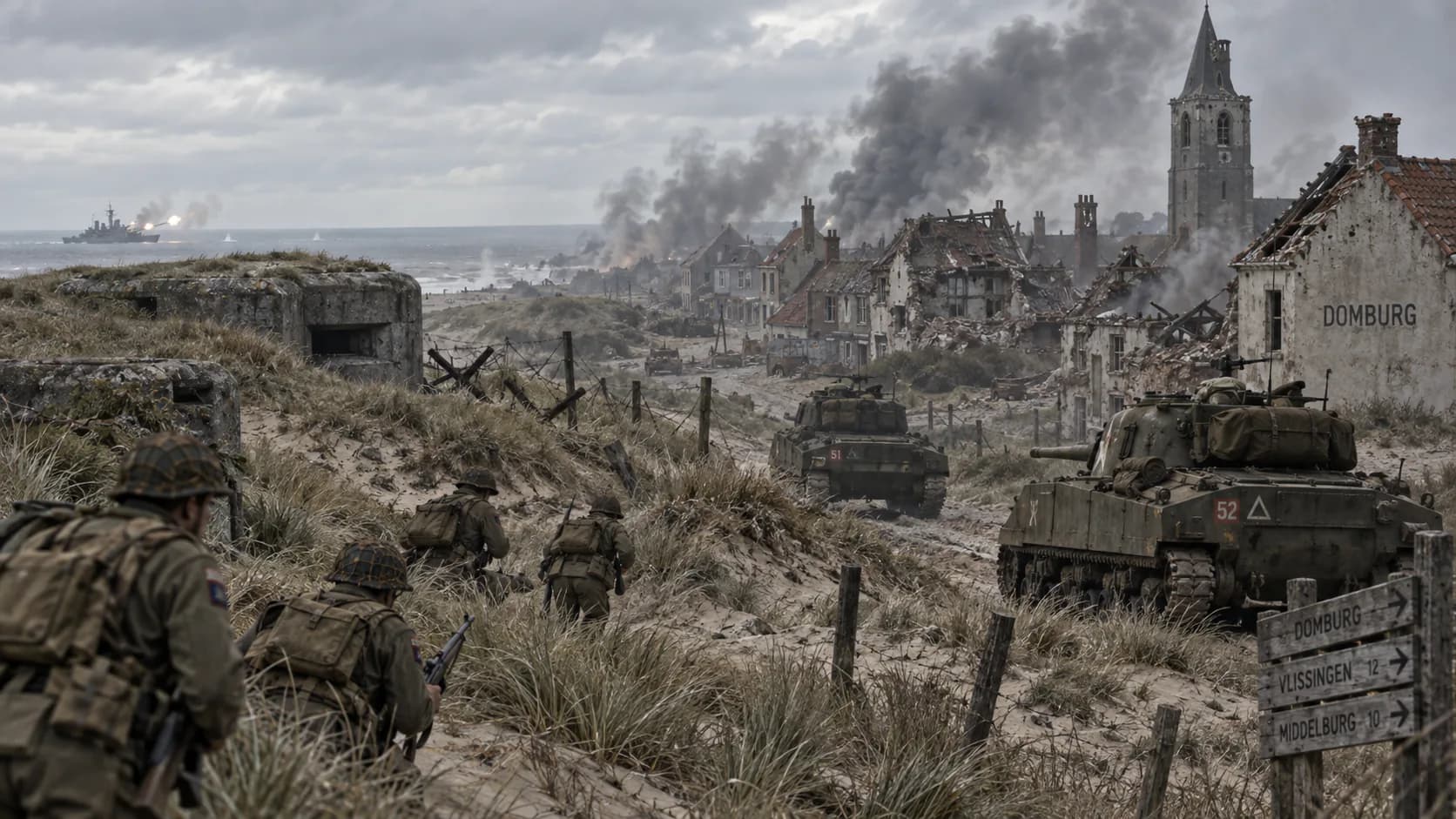
The Second World War was far more destructive. The German occupiers incorporated the Zeeland coast into the Atlantic Wall, the vast defensive system intended to stop an Allied invasion from the sea. Bunkers and military installations appeared in the dunes. The beach became a restricted zone, and several buildings disappeared or were damaged.
In 1944, Walcheren became a crucial battlefield. Antwerp had been liberated by the Allies, but access to its port through the Western Scheldt remained under German control.
To weaken the German defences on Walcheren, the Allies bombed the sea dikes at several points in October 1944. Large parts of the island were flooded. Domburg was hit hard as well.
The elegant Domburg of hotels, villas, artists and international visitors emerged from the war badly damaged. Then another chapter began.
History never disappears completely
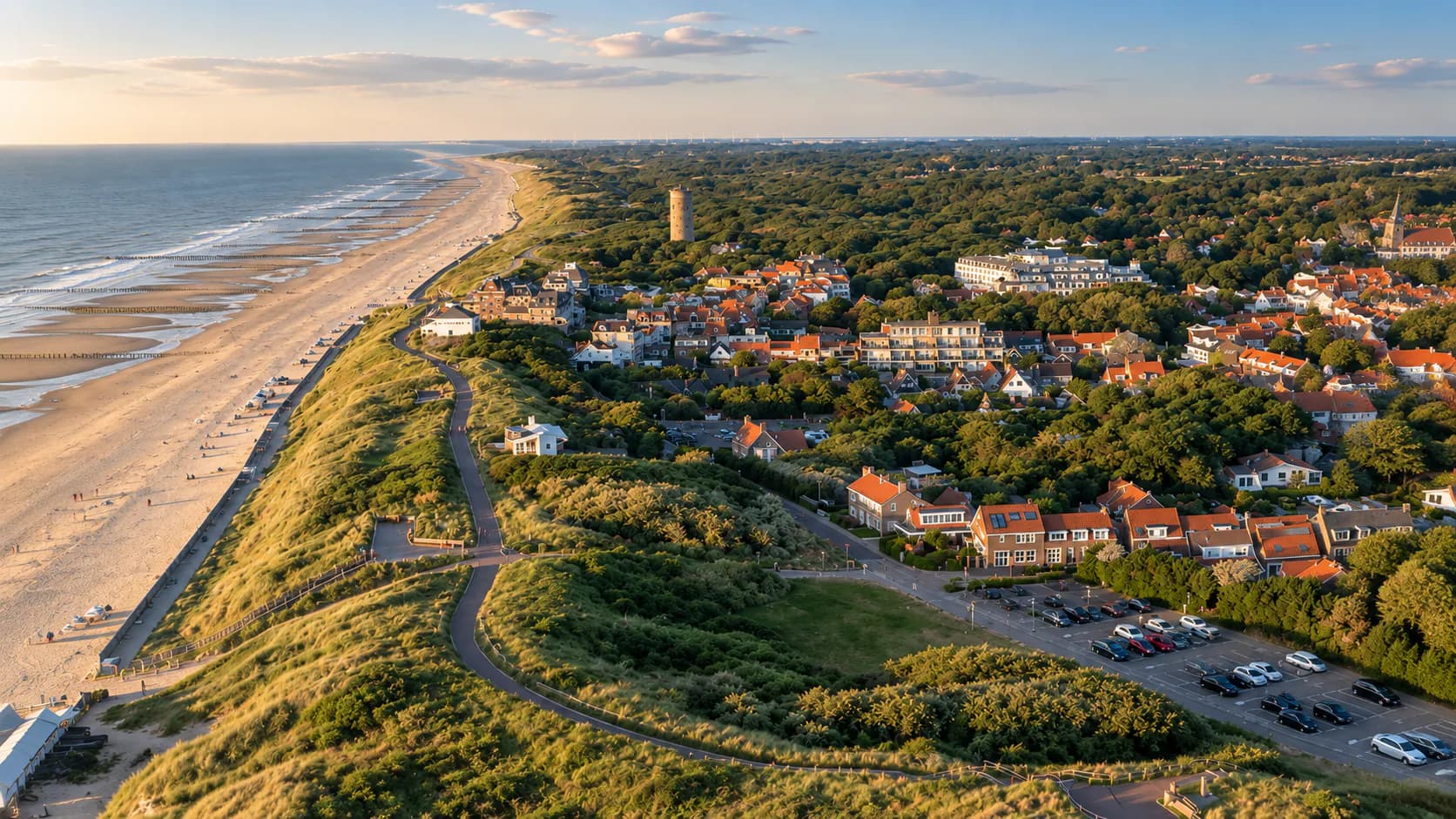
Walking through Domburg today, it is easy to pass all those layers of history without noticing them. People cycle to the beach. Terraces are full. Children eat ice cream. Surfers carry their boards towards the sea, and holiday homes welcome new guests every week.
Yet on almost the same coast where tourists now look out over the North Sea, merchants prayed to Nehalennia nearly two thousand years ago for a safe crossing. Vikings appeared off Walcheren. Medieval rulers built enormous defences. Royalty and aristocrats came to take the cure. Jan Toorop painted here. Piet Mondrian looked at the same sea and dunes and took steps towards an entirely new visual language.
And even the story of Nehalennia was not over.
Nehalennia returns
In 1970, a fisherman near Colijnsplaat on the Eastern Scheldt brought up fragments of Roman stone from the water. The find led to further investigation and recovery work.
Eventually, around two hundred altars and other votive stones were recovered, once again connected with Nehalennia. More than three centuries after a storm had exposed her altars at Domburg, the goddess appeared again in Zeeland.
Not at Domburg this time, but on the other side of the former Roman trading world in the Zeeland delta. The discovery made clear how important this coast had once been.
What might look like a peripheral corner of the Roman Empire had in fact belonged to a busy network of shipping, trade and religion.
Perhaps that is the best way to look at Domburg. On the map it is small. In history, far less so.
What you can still see today
Much of old Domburg has disappeared, but if you know where to look, a surprising amount remains.
- The Badpaviljoen, high on the dunes, recalls the fashionable Domburg of the late nineteenth century.
- Villa Carmen Sylva refers directly to the visit of Queen Elisabeth of Romania.
- The Marie Tak van Poortvliet Museum keeps the history of Domburg's artists' colony and the exhibitions that began in 1911 alive.
- Around 't Groentje, Badstraat and Wijngaardstraat, traces of the street pattern around the early medieval ring fort can still be recognised.
- Some of the archaeological finds from Domburg are preserved in museum collections, including the Zeeuws Museum in Middelburg.
- Anyone walking through Domburg and along the coast still moves through the same landscape that Toorop and Mondrian tried to capture more than a century ago.
In almost two thousand years, Domburg has reinvented itself again and again. Roman trading place. Medieval defensive site. Town. Seaside resort. Artists' colony. Holiday destination.
The buildings changed. The visitors changed. Even the coastline changed. But one element remained.
The sea.
The North Sea that carried Roman ships, saw Viking fleets appear, hid altars beneath the sand and centuries later drew artists to Zeeland because of the light above the water.
Some places preserve their history mainly in monuments. In Domburg, part of it still lies beneath the sand.
Frequently asked questions about Domburg's history
Why is Domburg called Domburg?
The name Domburg probably developed from Duinburg, the name of the large ring fort built here in the last quarter of the ninth century. The early medieval fortification lay around today's Badstraat and Wijngaardstraat.
When did Domburg become a seaside resort?
Organised sea bathing began in 1834, when two families from Middelburg used bathing machines at Domburg. In 1837 the foundation stone was laid for a coffee and bathing pavilion on the dunes.
Which artists worked in Domburg?
Jan Toorop became a central figure in Domburg's artistic community. Piet Mondrian first came to Domburg in the summer of 1908 and later returned several times. The Domburg exhibitions were held between 1911 and 1921.
Sources and further research
This article draws on historical and museum material from, among others, the following institutions:
Read more
Domburg also plays a central role in my novel Shadows over Domburg. The history in this article is real. The story that follows is fiction.
Get the first chapter free
When the tide went out at Domburg that morning, a man was lying on the beach. The watch was still on his wrist. The screen was still lit.