
Chapter 1
The Body
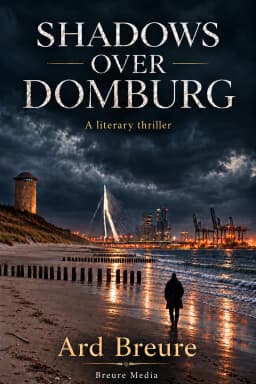
When the tide went out at Domburg that morning, Michael Harlan was lying on the beach.
Tom Jansen had not heard that name spoken aloud for five years. Last night Henk Maaskant had said it over the phone, without saying hello. Now the name lay here, on its side in the wet sand, with a bullet behind its left ear.
The mist hung low over the dunes and robbed the beach of its distance. All that remained was the cordon tape, a van with its rear doors open by the path through the dunes, and a young officer stamping his feet. Jansen knew that stamping. He had done it himself, years ago, on a quay in the Waalhaven, beside a man who had been pulled from a container. You stamped because your feet were cold. You kept stamping because you did not know what else to do with yourself.
‘No signs of a struggle,’ the officer said. ‘Watch still on.’
Jansen crouched.
There was a black sports watch on the left wrist, large and bulky, the kind soldiers and hikers wore. Its screen was still lit. A man who wore a watch like that always wanted to know where he was.
Pale skin. Short grey hair, wet against the temples. A faded tattoo on the forearm: eagle, globe, anchor. The emblem of the United States Marine Corps. After that, Harlan had gone into logistics. Rotterdam. Agricultural machinery, equipment for Ukraine. There had been talk of weapons too, but Jansen had never seen a file on that.
Only paperwork that never quite added up.
An ordinary Zeeland morning came through the police car’s radio. An arrest in Oostkapelle. A roadblock near Westkapelle. A registration number that needed checking. None of it had anything to do with Harlan.
The gulls stood on the sand a little way off. They had been there before the police, and soon the medical examiner would record what they had done. One took a few steps forward, stopped and waited. They would still be there when everyone else had gone.
His phone rang. Unknown number.
He answered without looking away from the body.
‘Jansen.’
‘Freja Larsen. Copenhagen CID.’ A calm voice. Good Dutch, with a trace of the north lingering in a few of the vowels. ‘We’ve been following Michael Harlan for months.’
Jansen looked at the body.
‘Had been.’
There was a brief silence at the other end.
‘Yes,’ she said. ‘Had been.’
‘What for?’
‘Harlan wasn’t just shipping agricultural machinery.’
‘What else, then?’
‘I won’t discuss that over the phone.’
Jansen stood up. His knees let him know he was no longer thirty.
‘Why call me, then? The station can tell you anything you want to know.’
‘The station will get its information.’
‘That wasn’t my question.’
It took her a few seconds to answer.
‘I’ll tell you one thing,’ she said. ‘So you know I’m not calling for nothing. There’s a Russian side to this case. I’m on my way. I want to talk to you before other people start getting involved.’
‘Other people.’
‘I’ll call you.’
She hung up.
Jansen held on to the phone a moment longer. A Russian side. Maaskant had said nothing about that. Or Maaskant had not known. Jansen did not know which of the two he liked less.
Outside the cordon he lit a cigarette. The wind took the smoke before he got anything out of it.
There was no ship in sight out at sea. He did not know whether that was normal in Domburg. In Rotterdam he could not remember a horizon without a hull on it.
Maaskant had not needed many words last night. He never had.
‘Zeeland has a body with a past in the port. I need someone who knows the containers.’
‘I’m retired.’
‘I know.’ Two seconds of nothing. ‘Temporary. One case.’
‘Why me?’
Then Maaskant had said the name, and after that he had waited. He knew he did not need to say anything more.
Five years ago Harlan had figured in a file that had never really been closed. They had known a great deal and been able to prove very little. Not long afterwards, one evening, Jansen had sat in the back seat of a car in Katendrecht and decided he had had enough.
He had thought that had brought something to a close.
The medical examiner was crouching beside Harlan now. A forensic investigator was photographing the wound behind the ear. The young officer stood with his hands deep in his pockets and no longer stamped his feet.
Jansen looked at the dunes. Beyond them, past the mist and a little over an hour of asphalt, lay the port. He had worked there for twenty years. He knew its patience.
Ports are never in a hurry.
Nor do they forget anything.
He dropped the cigarette into the wet sand, ground it out with his heel and walked to the car.