


Rotterdam
Markthal Rotterdam: the raw shine of a city full of stories
By Ard Breure · Last updated 21 August 2026
Introduction
Rotterdam is the setting of my thriller series — this is the city as I know it. Markthal Rotterdam is one of its sharpest faces: an arch of apartments over a covered market, a ceiling of fruit and fish, the smell of bread rising into a public room. It photographs well. That is not why it matters.
Rotterdam is a city that had to invent itself after the centre was destroyed. Markthal is one of the clearest recent answers to that history: housing, food and a square stacked into a single idea. How to read the building as architecture, and not as a food court with a mural, follows below.
What is Markthal Rotterdam?
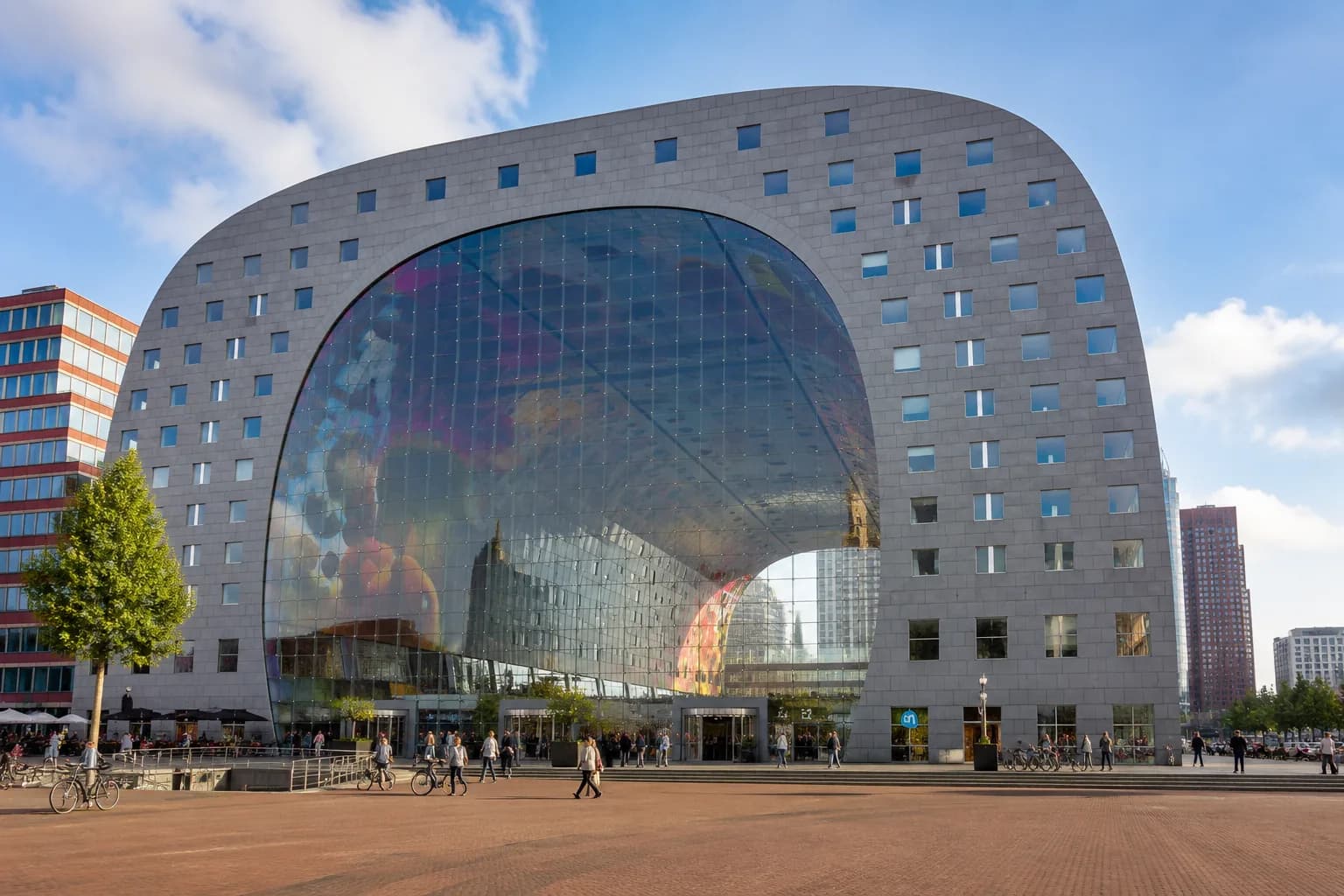
Markthal is a covered market hall in the Laurenskwartier, next to Station Blaak. It was designed by the Rotterdam office MVRDV and opened on 1 October 2014. The hall sits under a 40-metre arch of apartments. Underneath are parking and a supermarket. Around the sides are shops and restaurants.
The building was designed with 96 fresh-food stalls and shop units in the central hall, plus larger retail and restaurant units along the sides. Above them are 228 apartments. The point of the design is not a market with housing nearby. It is one hybrid: a public square created by private homes.
Official visitor information still treats it as a daily market you can walk into without a ticket. That is the right way to arrive. Look up first. Then decide whether you are here to eat, to shop, or simply to understand the city.
What makes Markthal special?
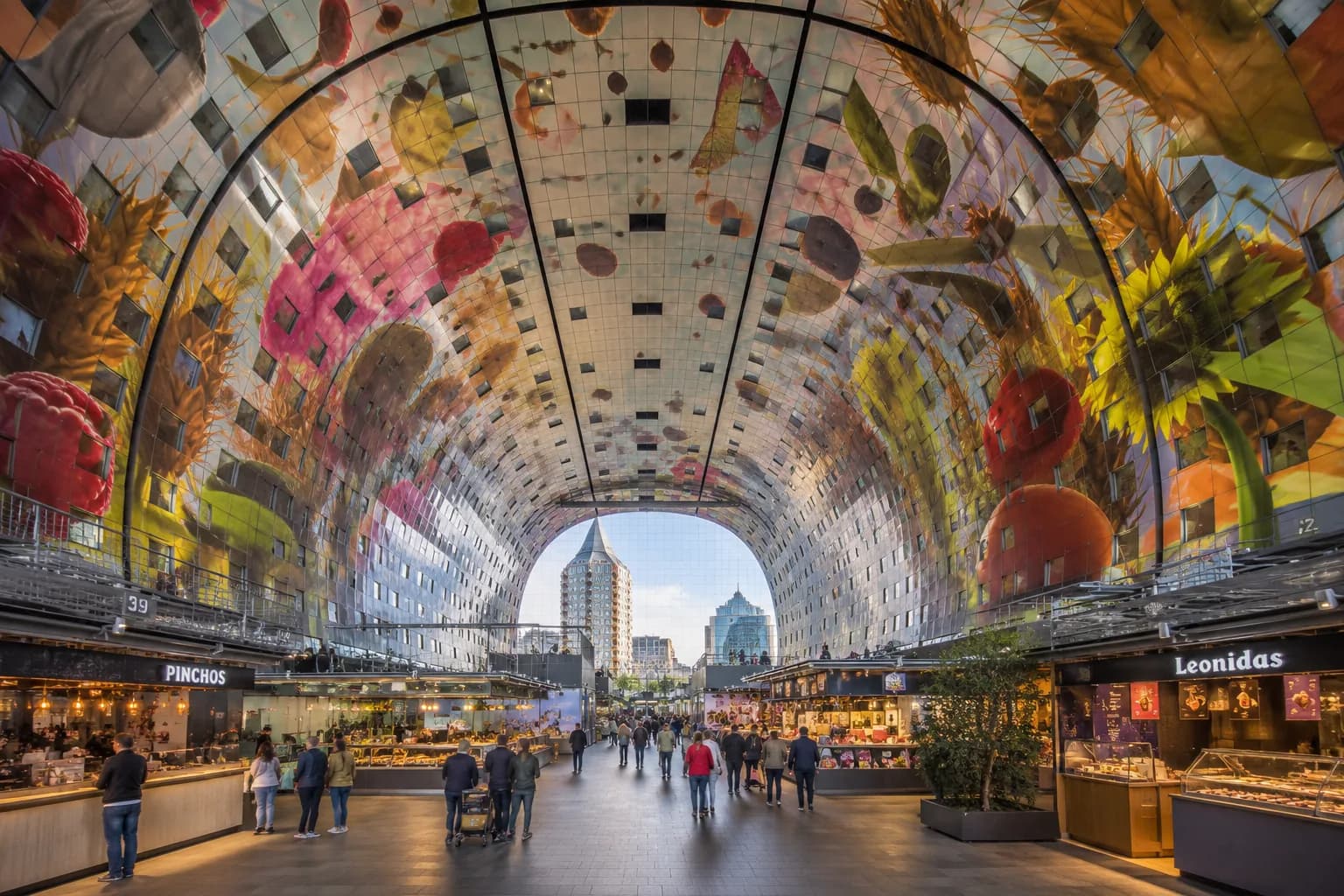
The first thing most people notice is the ceiling. The mural known as the Horn of Plenty, also called Cornucopia, is the work of Arno Coenen and Iris Roskam. It covers more than 11,000 square metres: fruit, vegetables, fish, flowers and insects, enlarged until they become architecture. The image refers to Dutch still-life painting of the seventeenth century, then refuses to stay inside a frame.
The panels are perforated aluminium. They carry the picture and they quiet the hall. The grey stone of the exterior and the floor is deliberately calm, so the interior can be excessive. At each end of the arch, a cable-net glass façade keeps the weather out without turning the square into a closed box. MVRDV describes it as the largest façade of its kind in Europe.
What lasts, after the first photograph, is the mixing. You eat under other people's kitchens. Those kitchens look into the hall through glass proofed against sound and smell. Living rooms face the other way, toward the Maas or the Laurenskerk. Markthal is special because it treats density as a civic pleasure, not as a problem to hide.
What can you eat at Markthal?
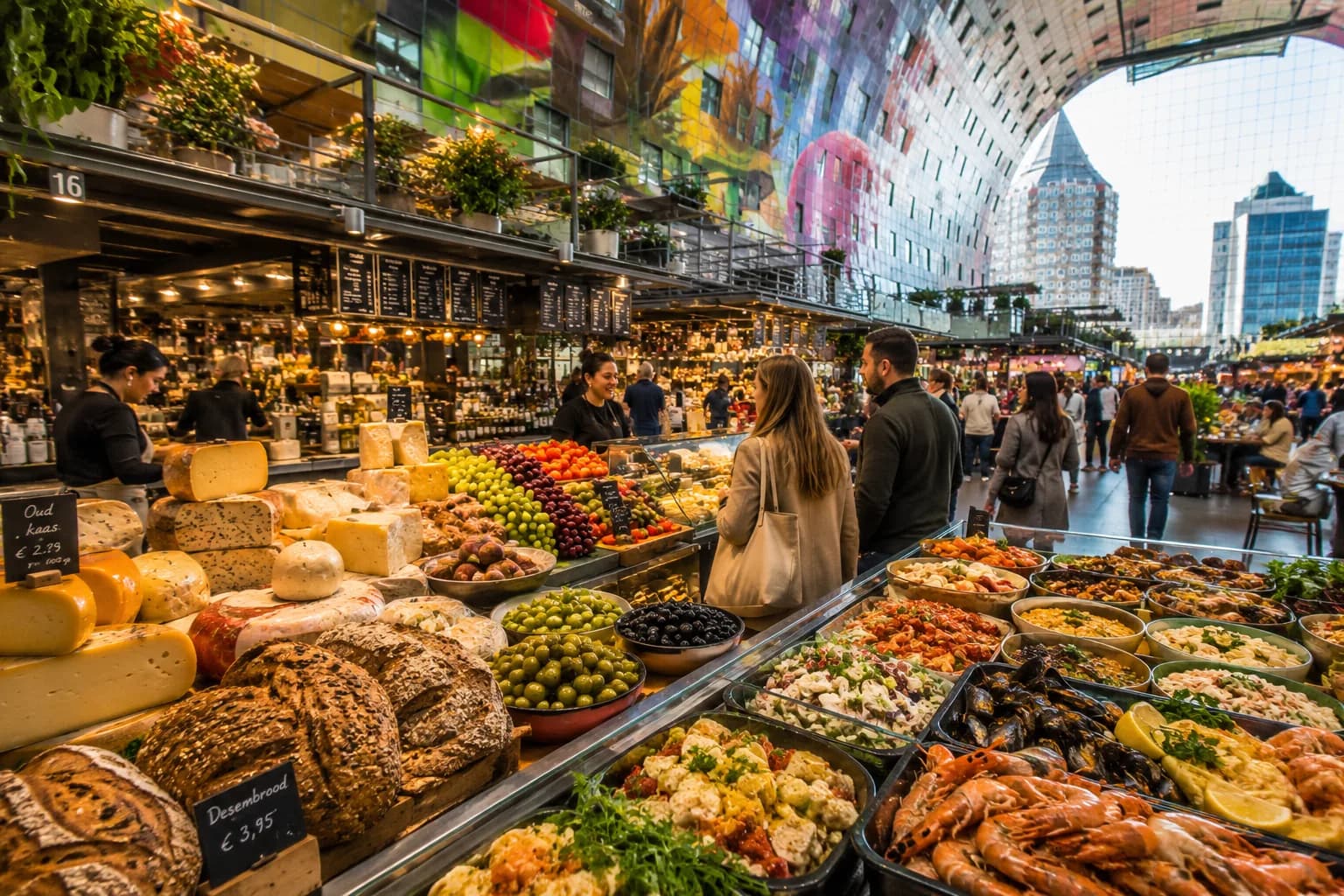
Eat as you would in a working market, not as you would in a restaurant with a fixed menu for tourists. The hall is built for fresh produce, fish, cheese, bread, coffee and cooked food from Dutch and international kitchens. Some stalls sell ingredients to take home. Others plate a meal you eat standing or at a small table.
Do not treat this page as a ranking of named stalls. Tenants change, and a list that pretends otherwise goes stale. Choose by what looks and smells good that day. If you want atmosphere, lunchtime and weekends bring more activity, but also more people. Earlier on a weekday is calmer, and often better if you came for the building as much as for lunch.
There is a supermarket on the level below the hall, useful if you are staying in the city and actually need groceries. Restaurants on the long outer sides have their own entrances and often keep later hours than the market itself.
Is Markthal Rotterdam worth visiting?
Yes, if you have even a short time in Rotterdam and you want to understand how the city builds. The visit is compact. You do not need a timed ticket. You can pass through on the way to the Cube Houses or the Laurenskerk and still have seen something essential.
It is less worth a detour if you hoped for a quiet neighbourhood market and nothing else. On Tuesday and Saturday the outdoor Binnenrotte market, immediately outside, is closer to that older idea of buying fish and flowers in the open air. Markthal is the covered argument beside it: food as a reason to make a public room inside a piece of housing.
That is where Markthal works best: not simply as a food hall, but as an introduction to modern Rotterdam.
How long do you need at Markthal?
Thirty to forty-five minutes is enough to walk the hall, look up, and step outside to see the arch from Blaak. If you sit down to eat, plan one to two hours. A simple loop with the Cube Houses and the Laurenskerk fills a morning or an easy afternoon without rushing.
You do not need half a day inside the building. Markthal is strongest as a first chapter, not as the whole book. Leave time for the streets around it. That is where the city continues the same argument in other forms.
What to see near Markthal
Almost everything worth pairing with Markthal is within a short walk of Station Blaak.
- Cube Houses (Kubuswoningen). Piet Blom's yellow cubes stand beside the hall. They are easy to photograph from the square. The Kijk-Kubus museum house is the place to see the interior if that curiosity is part of the visit. Our guide to the Cube Houses covers what you see and how long you need.
- Binnenrotte market. On Tuesday and Saturday the outdoor market fills the square outside. Combining the two markets is the most complete food visit.
- Laurenskerk. The late-Gothic church survived the wartime destruction of the centre. From Markthal you are looking toward one of the few remaining witnesses of the old city.
- Rotterdam Central Library. Another piece of postwar civic architecture, a short walk from the hall, and a useful pause if the square is crowded.
- Oude Haven and the Witte Huis. A few minutes further, the old harbour and Europe's first skyscraper give you water, ships and a different layer of the same city.
Markthal and Rotterdam architecture
Rotterdam is a city that had its centre taken from it. On 14 May 1940 the bombing emptied the middle of the town. What followed was not a brick-for-brick return of the old streets. It was a decision, repeated for decades, to treat the open ground as a place to invent. Some visitors still arrive hoping for canals and gables and feel short-changed. The city is not hiding a prettier version of itself behind the towers. This is the version it chose.
Markthal belongs to that line, not to a tourist circuit of isolated icons. The Cube Houses, the Erasmusbrug, the Depot Boijmans Van Beuningen and this arch are different answers to the same question: how do you make a centre after the centre is gone? MVRDV did not place a decorative roof over a shopping arcade. The market, the parking, the supermarket and the 228 apartments are one structure. Private housing is bent into a public square. The city gets a covered room; the homes get a reason to exist in the middle of Blaak.
Stand in the hall and the design becomes a set of views rather than a slogan. One way looks toward the Laurenskerk, the stone remnant. The other opens to the glass of the cable-net façade and the newer city beyond. Above you, kitchens face inward. Living rooms and bedrooms, which Dutch daylight law requires to receive real light, face the Maas or the church. The residents are not scenery. They are why the square could be built at all.
That stacking is Rotterdam at its most itself: functions mixed instead of zoned into polite distance, spectacle used to justify a civic interior, grey stone outside so that colour can happen within. The Horn of Plenty is not a sticker applied at the end. It is the inside of the arch made visible, a still life enlarged until it has to share the room with fish stalls and commuters. The building is theatrical. It is also practical. Both things can be true here, which is why the city kept building this way.
If you want that history in another form, read it. Rotterdam Wederopbouw, on our books about Rotterdam list, gathers a hundred buildings from the reconstruction years. It will not replace standing in Markthal. It will tell you why a hall like this could only have been built in this city.
Books about Rotterdam
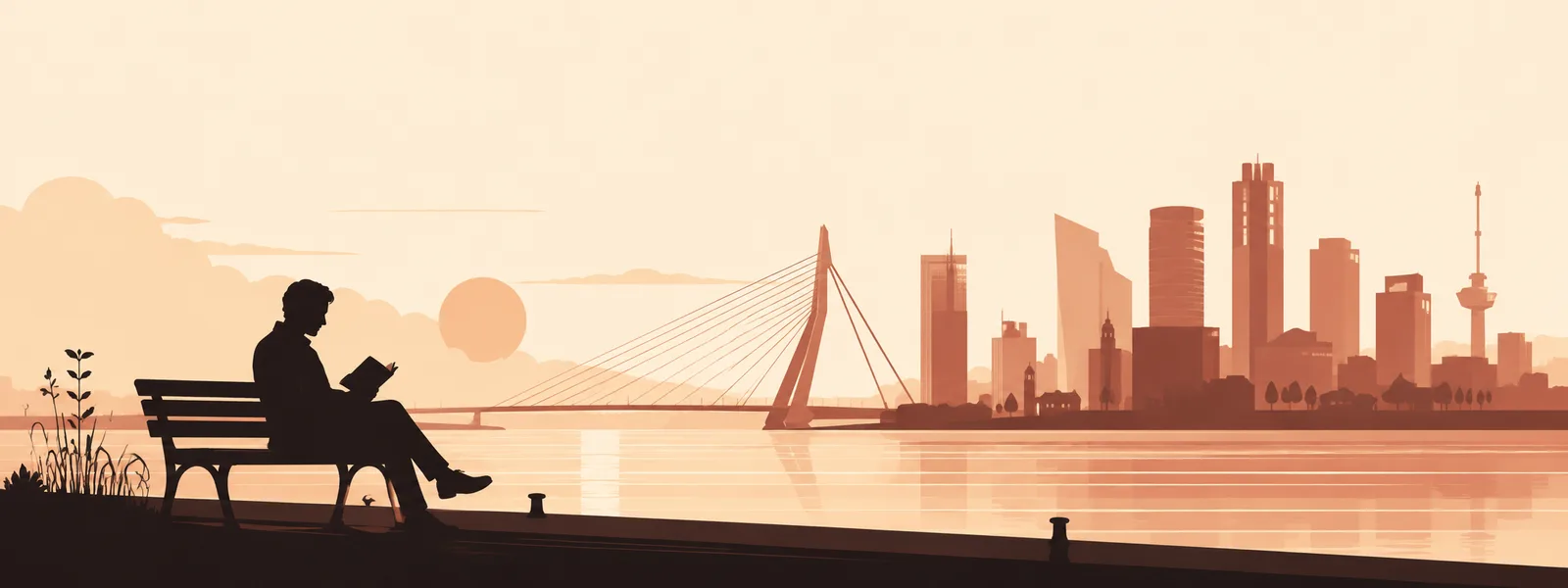
A visit to Markthal is a way into the city. Books are the slower way. If the hall leaves you wanting the harbour, the pre-war streets, the voice of the place, start with the Breure Media reading list of books about Rotterdam. The page is in Dutch. The titles are still the right ones: Bordewijk's Karakter for the city before the bombing, Jules Deelder for its tone, Hugo Borst for football and identity, and the reconstruction guide for the skyline you are walking through.
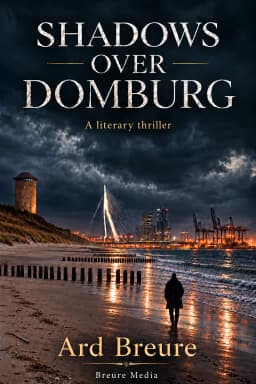
My own novel, Shadows over Domburg, is a literary thriller that begins on a Zeeland beach and runs into the Rotterdam harbour. It belongs on that list because the port is not a backdrop. It is the plot. Markthal will not appear as a postcard in it. The city underneath the postcard will.
Practical information
Address: Ds. Jan Scharpstraat 298, 3011 GZ Rotterdam.
Market hall hours:
- Monday to Thursday: 10:00–20:00
- Friday: 10:00–21:00
- Saturday: 10:00–20:00
- Sunday: 12:00–18:00
Restaurants on the outer sides and the supermarket downstairs keep their own hours. Holiday periods can differ. For the current official times, use the Markthal visiting page.
How to get there: Station Blaak is beside the building, with train, metro and tram. From Rotterdam Centraal it is a short metro or train ride, or a walk of about twenty-five minutes through the centre. There is an underground car park beneath the hall, open day and night. Cycling is the local default; bike parking sits around the square.
Entry to the hall is free. You pay for what you eat or buy. There is no need to book the market itself.
Visitor questions
Frequently asked questions
Yes, if you want a compact introduction to modern Rotterdam. The hall, the ceiling artwork and the surrounding architecture are the point, not a long shopping list. Combine it with the Cube Houses and, on Tuesday or Saturday, the outdoor market on the Binnenrotte.
Plan 30 to 45 minutes to walk the hall and look up at the ceiling. Allow 1 to 2 hours if you sit down to eat. A simple loop with the Cube Houses and the Laurenskerk takes a morning or an easy afternoon.
The market hall is open Monday to Thursday 10:00–20:00, Friday 10:00–21:00, Saturday 10:00–20:00 and Sunday 12:00–18:00. Restaurants on the outer sides and the supermarket downstairs keep different hours. Holiday hours can change, so check the official Markthal page before you go.
Yes. Walking into the hall and looking at the building is free. You pay only for food, drink or shopping. The Cube Houses museum nearby has its own ticket.
Fresh produce, fish, cheese, bread, coffee and cooked food from Dutch and international kitchens. It is a working market hall, not a fixed restaurant guide: stalls change, so choose by what looks and smells good that day.